Drafting Patterns and Understanding Allowances
Leather possesses significant thickness and structural density. Learn how to draft patterns that account for turnbacks, folds, and seam allowances accurately.
A common error among novice leatherworkers is transferring garment sewing logic directly to leathercraft. Fabric is thin and drapes easily. Leather, conversely, possesses substantial volume. When folded, it displaces mass. When sewn, the seam occupies physical space. Successful pattern drafting relies on calculating these spatial tolerances before a single cut is made.
Material Selection for Patterns
Before designing on computer software or directly on the hide, a physical prototype must be built. Standard printer paper is too flimsy to accurately simulate the drape of leather. Drafting patterns should be executed on heavy cardstock (minimum 110lb) or specific pattern paper. For designs that require an exact replication of thickness—such as complex bag gussets—crafting a prototype out of high-density EVA foam or scrap bonded leather is necessary to reveal stress points and design flaws.
Accounting for Thickness (The "Turnback" Allowance)
The most critical mathematical concept in leather pattern making is calculating fold allowances. When a piece of leather is folded back on itself—such as the spine of a bifold wallet—the outer layer has a longer distance to travel than the inner layer. If both the inner and outer panels are cut to the exact same length, the wallet will physically not be able to close without severe buckling and distortion.
The general formula requires adding extra length to the exterior piece based on the thickness of the leather. As a rule of thumb, for every 90-degree bend, you must add approximately the thickness of the leather multiplied by Pi divided by 2 to the outer layer. In practical application, crafters usually add a baseline of 5mm to 10mm to the exterior panel of a wallet to allow it to fold naturally, trimming any excess after the layers are glued in their folded state.
Seam Allowances
A stitch line running too close to the edge of the leather will tear out. Running it too far from the edge wastes interior volume, which is critical in items like cardholders where millimeters dictate whether a credit card fits.
Standard practice dictates that the stitch line should be placed approximately 3mm to 4mm from the finished edge. Therefore, when drafting a pocket that needs to hold an object 60mm wide, the pattern cannot simply be 60mm. It must be 60mm, plus two seam allowances (roughly 4mm each), plus an allowance for the thickness of the object itself. The final cut width might end up being 72mm to accommodate a 60mm card.
Using Acrylic and Metal Templates
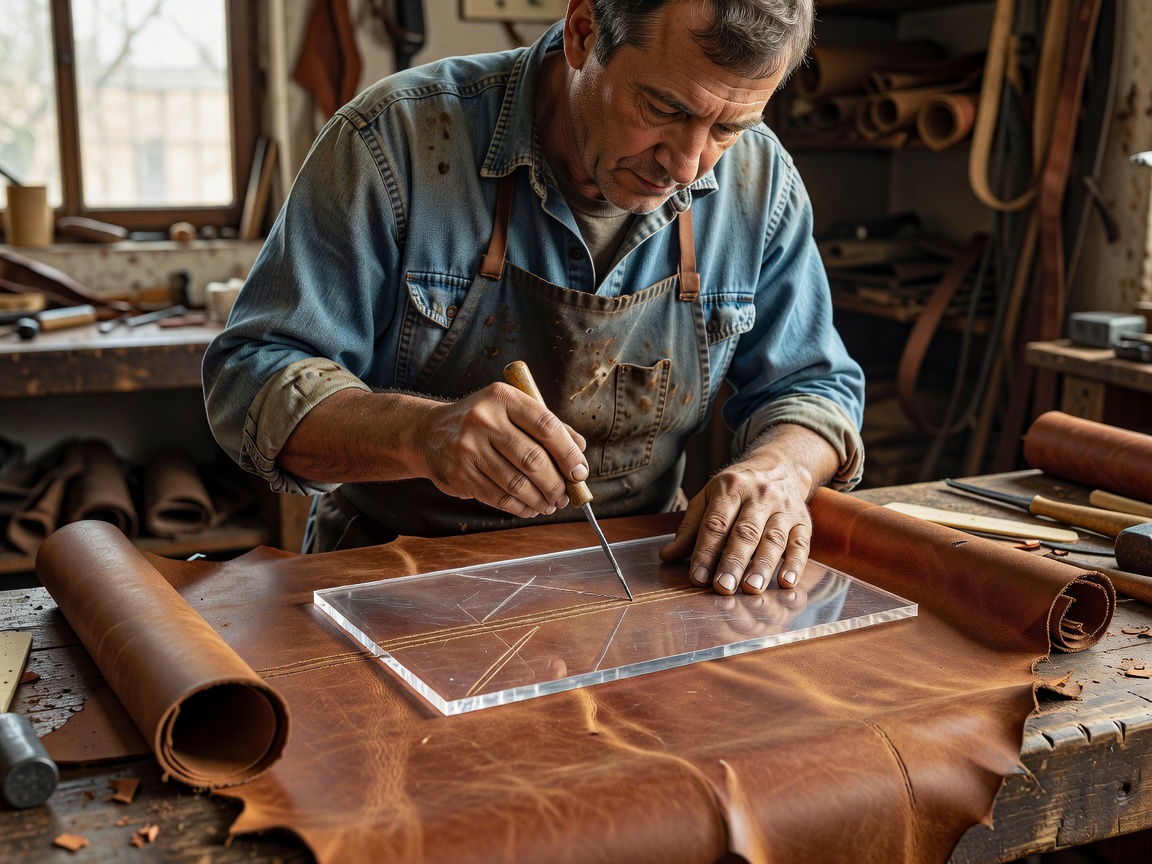
Once a paper pattern is verified, converting it into a permanent template saves hours of layout time. Acrylic templates, often cut with laser engravers, are highly popular because they allow the crafter to see the grain characteristics of the leather beneath the template, ensuring scars or blemishes are avoided during the cut. To use a template, it is placed on the leather, and a scratch awl is run heavily around the perimeter, leaving a physical groove to follow with the knife.
Conclusion
Drafting precise patterns removes the anxiety from cutting expensive hides. By building robust paper models, aggressively testing fold mechanics, and correctly calculating seam allowances, you eliminate the guesswork. The math done on the drafting table directly translates to the symmetry and functionality of the final leather product.